Have you ever wondered why your energy bills remain stubbornly high even though you were told your modern boiler is one of the most efficient on the market? It is a common frustration for many homeowners across West Sussex. With the 2026 energy situation feeling more complex than ever, trying to decode plumbing jargon can feel like learning a second language just to keep your family warm. The truth is that whilst every new gas installation is now a condensing combi boiler, simply having one on your wall doesn’t automatically guarantee the savings you were promised.
I understand the worry that comes with rising costs and the fear of being sold a system that isn’t right for your house size. You deserve a heating system that provides genuine peace of mind without the technical headache. This guide is designed to help you cut through the noise so you can understand exactly how this technology works and why it remains the reliable standard for existing UK homes.
We will explore the mechanics behind the heat, how to ensure your system is perfectly sized for your rooms, and the practical ways you can help your boiler reach its maximum performance levels.
What is a Condensing Combi Boiler? Clearing the Confusion
Do you feel like you’re being buried under a mountain of technical terms? It’s a common feeling when you start looking into home heating. The simplest way to understand a condensing combi boiler is to split the name in two. ‘Condensing’ describes the clever technology inside the box that saves you money, whilst ‘Combi’ describes the style of the boiler and how it delivers water to your taps.
A condensing boiler is designed to be incredibly efficient by capturing heat that would normally escape through your flue pipe. Instead of letting that energy go to waste, the system recycles it back into your heating loop. You won’t find a non-condensing model for sale in 2026. This became the law in the UK back in 2005 because the older, traditional boilers were simply too wasteful for a modern, energy-conscious world.
The ‘Combination’ element is what makes these units so popular. It’s a single, compact appliance that manages both your central heating and your instant hot water. It takes water directly from the mains and heats it on demand. This means you don’t need a bulky cold water tank in the loft or a large hot water cylinder taking up space in an airing cupboard. It’s a streamlined, all-in-one solution that provides heat exactly when you need it.
This space-saving design is why these systems are the favourite choice for many homeowners in Worthing and Bognor Regis. If you’re living in a flat or a terraced house where every square foot counts, removing old, redundant tanks can give you back valuable storage space. It’s a practical, honest way to modernise your home without a complicated setup. While domestic properties benefit from these compact solutions, commercial premises often require more complex maintenance; for these needs, The CFS Group provides comprehensive facilities management to ensure businesses operate seamlessly and efficiently.
Condensing vs. Combi: The Key Differences
It is helpful to remember that ‘condensing’ is a badge of efficiency rather than a separate category of appliance. Almost every new boiler we install today is a condensing model, whether it’s a combi, a system, or a regular boiler. Whilst a condensing combi boiler is perfect for most small to medium homes, larger properties with multiple bathrooms might occasionally require a condensing system boiler to keep up with the demand. For the vast majority of families, the combi remains the most dependable and straightforward option available.
How Condensing Technology Actually Saves You Money
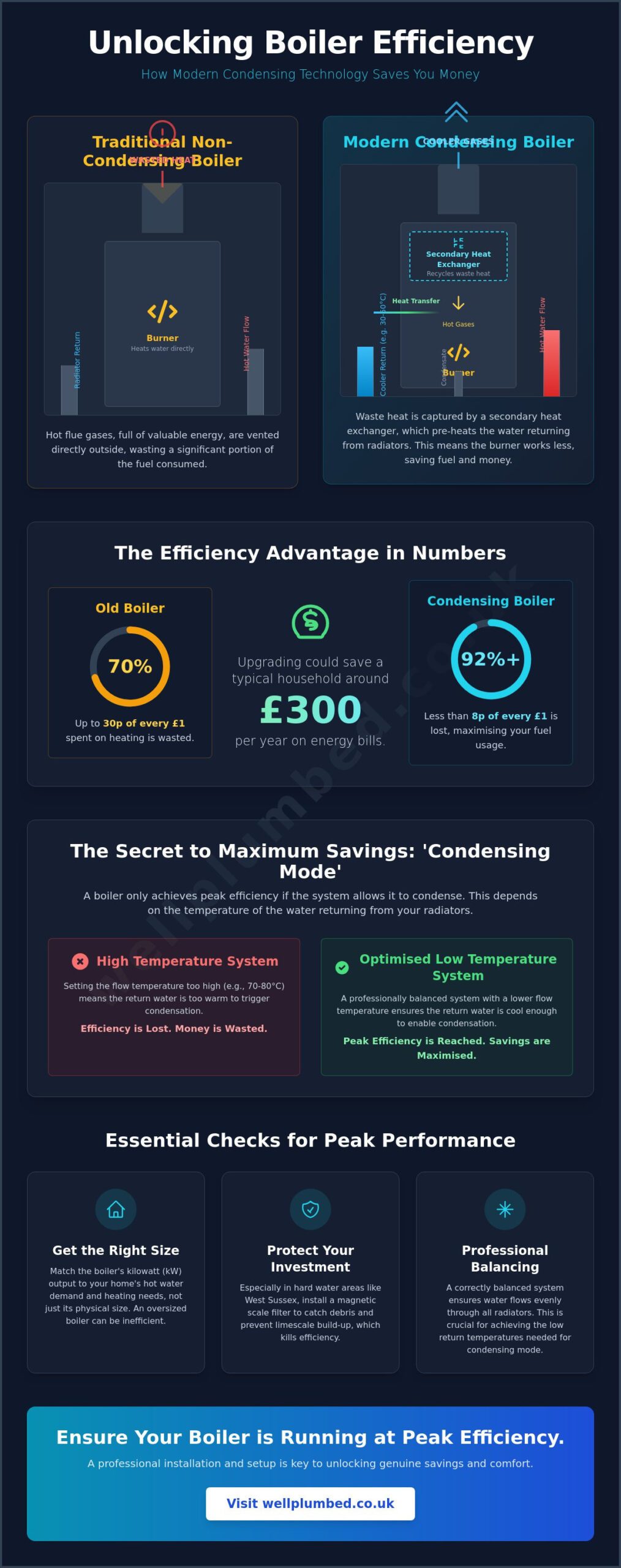
How does a condensing combi boiler actually lower your bills? The secret lies in a clever component called the secondary heat exchanger. In older, non-condensing systems, the hot gases produced by burning fuel were simply vented outside through the flue pipe. Now, that waste heat is captured and used to pre-heat the cold water returning from your radiators. By recycling this energy, the burner doesn’t have to fire as often or as intensely, which helps you reduce gas consumption for space heating.
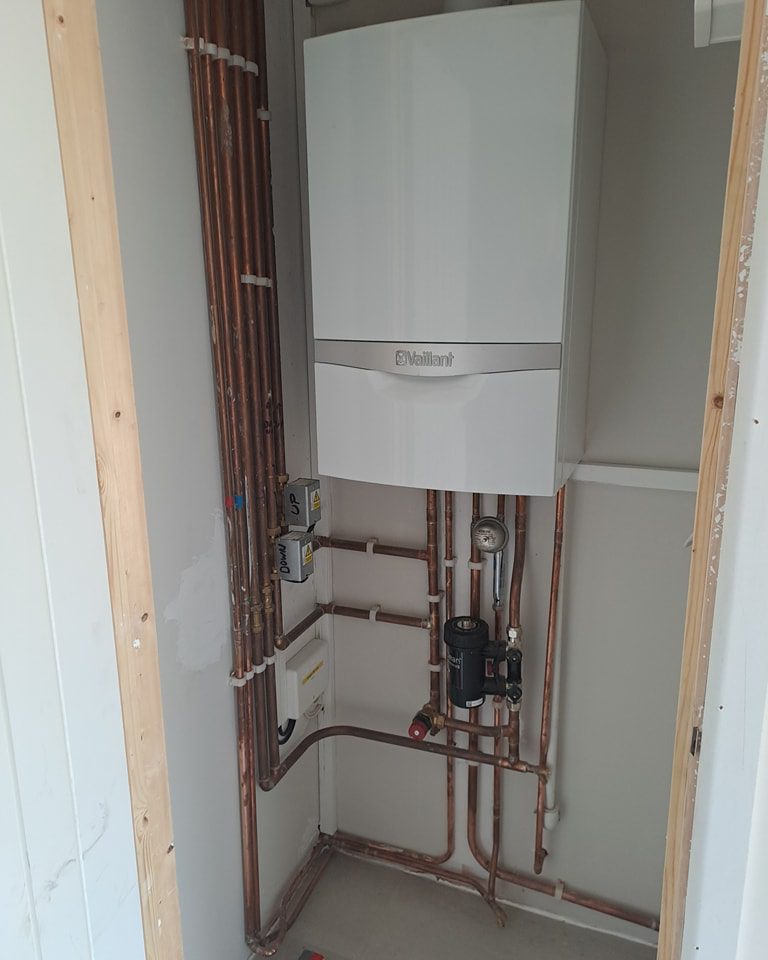
Research shows that upgrading from an old boiler with 70% efficiency to a modern unit with 92% efficiency can save a household around £300 per year on energy bills. It’s a significant saving that also reduces your home’s carbon footprint whilst keeping your family warm. However, simply hanging a new box on the wall isn’t enough to guarantee these results. We call this the ‘Heat Geek advantage’; the real secret is in system balancing. If your radiators aren’t correctly balanced, the water returns to the boiler too hot, which stops the condensing process in its tracks. This is why we take the time to precisely calibrate every Vaillant boiler installation we carry out.
The Importance of Low-Temperature Heating
Your boiler only saves you money when it is actually in ‘condensing mode’. If your flow temperature is set to the traditional 70°C or 80°C, the return water will be too warm to allow the secondary heat exchanger to do its job. We often find that lowering this temperature slightly makes a huge difference to monthly outgoings without sacrificing comfort. Professional commissioning ensures your new Vaillant or Baxi performs exactly as the manufacturer promised. Condensing mode is the state where the boiler operates at its maximum theoretical efficiency by successfully recovering latent heat from water vapour.
Choosing the Right Combi Boiler for Your West Sussex Home
How do you decide which model is right for your property? It isn’t just about picking the most famous brand or the lowest price. You must match the kilowatt (kW) output to your specific lifestyle. A common misconception is that a smaller home always needs the lowest power. Whilst a 24kW unit might be plenty for your radiators, you may actually need a 30kW or 35kW model to ensure your hot water flow is strong enough for a decent shower. Modern high-output units are now sophisticated enough to handle larger Chichester family homes that previously relied on old-fashioned tanks.
When modernising the infrastructure of such period properties, many homeowners also look to enhance their interior spaces with authentic historical details. To explore the cultural significance of colour and design in traditional homes, you can find out more through the expert resources at Nicholas Wells Antiques.
We often recommend Vaillant for our neighbours in coastal areas like Bognor. Their high-quality German engineering provides the kind of reliability you need when the sea air is a factor. Living in West Sussex also means dealing with hard water. Over time, limescale can settle in your heat exchanger and quietly kill your efficiency. We always suggest including a magnetic scale filter with your new condensing combi boiler. This simple addition catches debris and protects your investment for the long term. To keep things transparent, we provide fixed-fee installations so you don’t have to worry about hidden costs or unexpected surprises halfway through the job.
Why Local Expertise Matters
Every town has its own architectural quirks. The plumbing layouts in a historic Chichester townhouse are worlds apart from a modern terrace in Worthing. A local Gas Safe engineer understands these specific challenges and can ensure your system is piped for maximum flow. This expertise is also vital for your paperwork; a professional Vaillant boiler installation is required to keep your manufacturer’s warranty valid. Making the switch to a modern condensing combi boiler should be a straightforward process that leaves you with a warmer home and total peace of mind.
Ready for a Warmer, More Efficient Home?
Upgrading your heating system doesn’t have to be a source of technical stress. By choosing a modern condensing combi boiler, you are investing in a system that is designed to lower your bills whilst providing instant comfort. The key is ensuring that your new unit is installed with precision, balanced correctly, and protected against the hard water challenges we face here in West Sussex. It’s about more than just a new appliance; it’s about the long-term health and efficiency of your home.
We’ve been serving families across West Sussex since 2008 as Vaillant Advance Partners and Heat Geek Verified Installers. This means we don’t just hang boilers; we ensure they actually perform at their peak efficiency. You deserve a system that works for your specific home size and hot water needs without any aggressive sales tactics or hidden fees. If you’re ready to clear the confusion and get your heating back on track, I’m here to help.
Speak to Ben today for an honest, fixed-fee quote on your new boiler
Taking the first step toward a more reliable, energy-efficient home is easier than you think, and we are here to guide you every step of the way.
Common Questions About Your Heating System
Is a condensing boiler the same as a combi boiler?
No, they aren’t the same thing, although almost every modern unit is both. ‘Condensing’ describes the internal technology that captures waste heat to save you money. ‘Combi’ refers to the style of the boiler. A condensing combi boiler is simply a combination boiler that uses this efficiency technology. You can also get condensing system boilers or regular boilers, which are used in different types of property layouts.
Do I need a water tank with a condensing combi boiler?
You don’t need any external water tanks with this system. Unlike older regular boilers that require a cold water tank in the loft and a hot water cylinder in an airing cupboard, a combi heats water directly from the mains. This is a huge advantage for homeowners in West Sussex looking to reclaim storage space. It makes the installation much simpler and removes the risk of tanks leaking or freezing in the roof during winter.
How long does a modern condensing combi boiler last?
You can generally expect a high-quality model to last between 10 and 15 years. The actual lifespan depends heavily on how well the system is maintained and the quality of the initial installation. Regular annual servicing is essential to keep the internal components clean and efficient. Using a magnetic scale filter is particularly important in our local area to prevent hard water damage from shortening the life of your heat exchanger.
Can a condensing combi boiler be repaired if it breaks down?
Yes, most modern boilers are designed to be repaired if a component fails. Common issues like a faulty pump or a blocked sensor can usually be fixed by a qualified engineer. If the main heat exchanger fails and the unit is out of warranty, it’s often more cost-effective to consider a new installation. Keeping up with your annual servicing is the best way to catch small issues before they become expensive repairs.